You're Not Overeating. You're Under-Informed. Here's How Macro Tracking Changes Everything.
The science-backed case for counting macros—not just calories—and where to get personalized targets fast.
Updated 2026-05-02 · Physiq
You're Not Overeating. You're Under-Informed. Here's How Macro Tracking Changes Everything.
The science-backed reason why counting macros — not just calories — is the #1 strategy for sustainable fat loss in 2025.
Picture this. You've been "eating healthy" for weeks. Meal prepping on Sundays. Skipping dessert. Choosing salads over sandwiches. You step on the scale expecting a win — and the number hasn't moved. Or worse, it's gone up.
You're not lazy. You're not broken. You're not failing at willpower.
You're flying blind.
The single biggest reason people struggle to lose weight — and keep it off — isn't lack of effort. It's lack of structure. Specifically, the kind of structure that tells your body exactly what it needs, when it needs it, and in what proportions to burn fat, preserve muscle, and feel human while doing it.
That structure has a name: macro tracking. And in 2025, it's no longer just for elite athletes and competitive bodybuilders. It's for the busy professional who can't figure out why the gym isn't moving the scale. For the woman who's been eating 1,200 calories and wondering why she's exhausted and still not losing. For the guy in his 30s who's put on weight despite working out consistently. For anyone who has ever wondered: "What am I actually supposed to eat to reach my goal?"
This article answers that question — backed by the latest research, grounded in real physiology, and powered by one of the best free tools available on the internet today: PhysiqMacros.com.
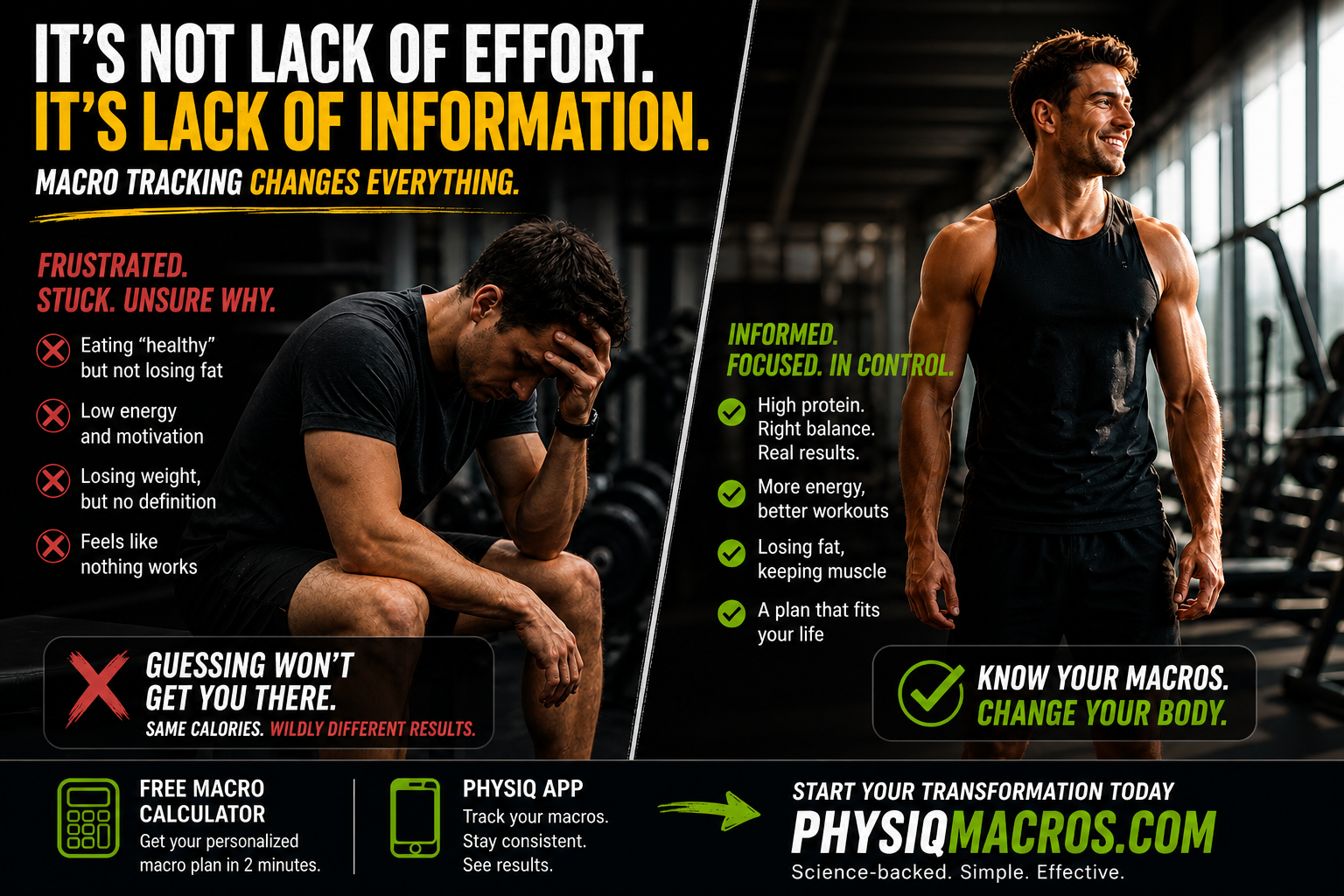
What Is Macro Tracking? (And Why It Beats "Eating Clean")
Before we get into the how, let's get clear on the what.
Macros — short for macronutrients — are the three categories of nutrients that provide all of the calories in everything you eat: protein, carbohydrates, and fat. Every food is a combination of these three. Even the "clean" ones.
Macro tracking means knowing not just how many total calories you eat each day, but how those calories are split between protein, carbs, and fat. And that distinction — the split, not just the total — is what transforms ordinary calorie counting into a genuine body transformation tool.
Here's the difference in plain terms. Two people both eat 1,800 calories a day. Person A eats mostly carbohydrates and fat with minimal protein. Person B eats the same 1,800 calories but anchors their intake with high protein, moderate carbohydrates, and controlled fat.
After 12 weeks in a calorie deficit, Person A has lost weight — but a significant portion of that weight is muscle tissue, leaving them lighter but softer, with a slower metabolism and less physical capacity. Person B has lost similar scale weight — but nearly all of it is fat. They're leaner, stronger, more energetic, and their metabolism is better preserved.
Same calories. Wildly different results. The difference is macros.
This is precisely why, as the PhysiqMacros Macro Academy explains, calories move the scale — but protein, carbs, and fat steer muscle, energy, and adherence. Macro targets beat vague "healthy eating" every time for fat loss, muscle preservation, and performance.
The Science: Why High Protein + Macro Tracking Works
This isn't bro-science or fitness Instagram wisdom. The evidence base for protein-forward macro tracking as a fat loss strategy is extensive, peer-reviewed, and growing stronger in 2025.
Protein Preserves Muscle While You Lose Fat
A 2024 systematic review and meta-analysis published in Clinical Nutrition ESPEN, examining adults with overweight and obesity pursuing weight loss, concluded that enhanced protein intake significantly prevents muscle mass decline in adults who are aiming for weight loss. The same research found that a protein intake exceeding 1.3g per kilogram of body weight per day is expected to result in increased muscle mass — even during a calorie deficit.
This is the central mechanism that makes protein the non-negotiable anchor of any effective fat loss plan. Without adequate protein, your body breaks down lean tissue for energy alongside fat. With it, muscle is protected — and the weight you lose comes primarily from fat stores rather than the lean mass that gives your body shape and keeps your metabolism running.
Higher Protein Predicts Leaner Body Composition During Weight Loss
A 2025 pre-print from the International Weight Control Registry, published in Research Square, reinforced this with real-world data from 203 participants engaged in purposeful weight loss. Dietary protein plays an important role during weight loss by stimulating muscle protein synthesis (MPS), a metabolic process in which ingested amino acids are synthesized into muscle protein. The study found that participants with higher protein intakes consistently demonstrated leaner body composition outcomes — less body fat percentage and higher muscle mass percentage — compared to those eating less protein at the same caloric restriction level.
In short: eat more protein while losing weight and you end up leaner, not just lighter.
Protein Is the Most Thermogenic Macronutrient
Diets rich in protein show promise for both preventing and managing obesity, due to protein's ability to induce a greater diet-induced thermogenic response compared to carbohydrates and fats. What this means practically is that your body burns more calories digesting protein than it does processing carbs or fat — a metabolic advantage that compounds over weeks and months of consistent tracking.
Macro Tracking Enables Personalized Nutrition — the #1 Trend in 2025
Personalized nutrition is a cornerstone of weight loss in 2025, with emerging approaches from genetic testing to AI-driven meal planning all centering on one principle: one-size-fits-all dieting doesn't work. What does work is tailoring your calorie and macronutrient targets to your specific body, goal, activity level, and eating preferences.
This is exactly what a properly structured macro plan delivers — and what generic "eat less, move more" advice will never provide.
The 3 Macros Explained: Your Body's Operating System
Understanding what each macronutrient does transforms macro tracking from a numbers game into a practical tool for steering your body.
Protein: The Non-Negotiable
Protein is the foundation of any serious fat loss or body transformation plan. It builds and repairs muscle tissue, keeps you fuller longer (it's the most satiating macronutrient by a significant margin), supports hormone function, and as the research above confirms, is thermogenic — meaning your body burns more calories digesting it.
For fat loss, PhysiqMacros recommends targeting approximately 0.7–1.0g of protein per pound of body weight daily, with higher intakes toward the top of that range during a calorie deficit when the muscle-preservation signal matters most.
Carbohydrates: Fuel, Not the Enemy
Carbohydrates are your body's preferred fuel source, especially during training. They power your workouts, protect muscle tissue from breakdown during periods of calorie restriction, regulate blood sugar, and support brain function, mood, and energy. The idea that carbohydrates inherently cause fat gain is one of the most damaging nutrition myths still circulating — and it's keeping millions of people exhausted, underperforming, and stuck.
Carbs cause fat gain only when total calories exceed expenditure. Within your macro targets, carbohydrates are an asset.
Fat: Essential, Not Optional
Dietary fat is required for hormone production, including the reproductive hormones that are particularly important for women. It supports joint health, brain function, and the absorption of fat-soluble vitamins A, D, E, and K. Dropping fat too aggressively — a common mistake on very-low-calorie diets — has real physiological consequences that go far beyond slow results.
A minimum fat intake of roughly 0.35g per pound of body weight (around 25–35% of total calories) is a sound baseline for most people. This is not a macronutrient to eliminate.
How to Calculate Your Macros for Weight Loss: A Step-by-Step Guide
This is the question that brings most people to macro tracking: "How do I actually calculate my macros?" Here's the process — simplified.
Step 1: Determine your TDEE (Total Daily Energy Expenditure)
Your TDEE is the total number of calories your body burns per day, accounting for your basal metabolic rate (BMR — the calories burned just keeping you alive) and your activity level. This is your maintenance number — the caloric equilibrium point where your weight stays stable.
Step 2: Set your goal-based calorie target
For fat loss, apply a moderate calorie deficit of 15–20% below TDEE. For muscle gain, a small surplus of 10% above TDEE. For body recomposition — losing fat and building muscle simultaneously — eat at or very near maintenance with protein maximized.
Step 3: Anchor protein first
Before distributing the remaining calories between carbs and fat, lock in your protein target: 0.7–1.0g per pound of body weight. Protein is set first because it's non-negotiable for muscle preservation and appetite management.
Step 4: Split remaining calories between carbs and fat
The ratio of your remaining calories between carbohydrates and fat is flexible — guided by your eating style, training demands, and personal preference. This is where macro tracking becomes a tool that adapts to you rather than forcing you into a rigid template.
Step 5: Track, observe, and adjust
No calculated starting point is perfect. The goal is to track consistently for 2–3 weeks, observe the trends (not the daily noise), and make small, evidence-based adjustments. If fat loss has stalled despite accurate tracking, a reduction of 100–150 calories or an increase in daily steps is typically the right first move.
The fastest and most accurate way to do all of this for free: PhysiqMacros.com. Their free macro calculator uses the scientifically validated Mifflin-St Jeor equation to calculate your personalized BMR and TDEE, then builds out your full macro targets based on your goal, activity level, and chosen eating style — in under two minutes, with zero signup required.
Who Benefits Most from Macro Tracking? (Spoiler: Probably You)
Macro tracking isn't exclusively for competitive athletes or nutrition obsessives. The people who benefit most from it tend to fall into recognizable categories — and the common thread is that they've been doing everything "right" by conventional wisdom and still not getting where they want to be.
The plateau dweller. You lost weight at first, then it stopped. You haven't changed anything. The scale hasn't moved in weeks. Macro tracking reveals the hidden answer — whether it's calories creeping up, protein dropping too low, or activity overestimation — and gives you the lever to pull to restart progress. The PhysiqMacros guide on fat loss plateaus covers the exact audit process.
The person losing weight but still looking "soft." If you're losing scale weight but not seeing the lean, defined physique you're working toward, you're almost certainly losing muscle alongside fat. Macro tracking — specifically anchoring protein at the right level — is the direct fix. Losing fat while preserving lean mass is a physiology problem, and macros are the solution.
The woman who's been eating very little but not losing. Chronic under-eating — especially the 1,200-calorie myth that pervades women's fitness culture — triggers metabolic adaptation, hormonal disruption, and muscle loss that paradoxically makes fat loss harder over time. Macro tracking often reveals that the path forward involves eating more, not less — specifically more protein and more total calories than a restrictive diet has been providing. The PhysiqMacros guide to best macros for women addresses this directly.
The man in his 30s with creeping body fat. Testosterone naturally declines with age, activity levels often drop with career and family demands, and muscle mass decreases without deliberate resistance training and adequate protein. Macro tracking provides the structure to reverse these trends systematically — PhysiqMacros' guides for men are specifically built around these challenges.
The fitness beginner who wants to do it right from the start. If you're new to structured nutrition, macro tracking from day one means you never have to guess, never have to do the "intuitive eating vs tracking" debate, and never have to restart after months of no results. Starting with structure beats having to find it after failure.
The athlete or serious trainer whose performance doesn't match their effort. If your training is consistent but your body composition isn't moving in the direction you expect, nutrition is almost always the missing variable. Macro tracking aligns your fuel with your training demands — carbohydrates for performance, protein for recovery, fat for hormonal health.
The 2025 Macro Tracking Trend: Structure Meets Smart Tech
The fitness and nutrition landscape has shifted significantly in the last two years. The best macro tracking apps today function as integrated health hubs, connecting with a wide range of devices and platforms to offer a seamless user experience — syncing with Apple Watch, smart scales, and health platforms to give users a comprehensive, real-time picture of their nutrition and body composition data.
This integration of tracking technology with evidence-based nutrition science represents a genuine democratization of elite-level sports nutrition. What used to require a registered sports dietitian and a food lab is now available to anyone with a smartphone.
The Physiq Macro Tracker app, available free in the Apple App Store, is built precisely for this moment. The workflow is seamless by design: use the PhysiqMacros.com free calculator to establish your personalized daily macro targets, then log your daily food intake in the Physiq app using the integrated USDA food database — the same database used by professional dietitians and nutrition researchers.
The combination of a scientifically grounded calculator and a fast, accurate daily logging tool eliminates the two biggest failure points in macro tracking: not knowing what your targets should be, and not having an easy way to track against them.
Macro Tracking for Every Eating Style: One Framework, Infinite Flexibility
One of the most common objections to macro tracking is the assumption that it requires eating a specific way — that it's only for people following a standard Western diet, or that it conflicts with dietary choices like veganism, keto, or intermittent fasting.
The reality is the opposite. Macro tracking is a framework, not a food list. It works with virtually any eating style because it's built on the universal principle of energy balance and macronutrient function — not specific ingredients.
PhysiqMacros.com supports eight distinct eating styles in its calculator, with dedicated guides in the Macro Academy for each:
Keto — Keto macro tracking means a strict carbohydrate ceiling (20–50g per day), adequate protein to prevent muscle loss, and fat filling the remainder of your calorie budget. It works when the math works. The guide covers how to set the numbers, troubleshoot stalls, and stay consistent without guesswork.
Intermittent fasting — IF macros are simply your normal daily targets compressed into a shorter eating window. Timing is not a substitute for hitting your calorie and protein targets — the guide makes clear what IF actually changes (eating window) and what it doesn't (your macro requirements).
Vegan and vegetarian — Plant-based eating requires strategic protein stacking — soy, legumes, seitan, and supplemental protein powders to reach the targets that support muscle preservation during fat loss. PhysiqMacros' vegan and vegetarian guides cover the specific food combinations and macro structures that make plant-based macro tracking work.
Mediterranean — One of the most clinically validated dietary patterns in the research literature maps cleanly onto a macro framework. Mediterranean diet macros use olive-oil-aware fat targets, fiber-rich carbohydrate sources, and protein anchored by fish and legumes — adaptable for cutting, maintaining, or lean bulking.
PSMF (Protein Sparing Modified Fast) — For those who need aggressive, short-term fat loss, PSMF is the most extreme application of macro precision: very high protein, near-zero fat, near-zero carbohydrate, under medical supervision. Not a lifestyle approach, but a clinically researched short-term protocol with real results when executed correctly.
Whatever way you prefer to eat, there is a macro structure that supports it. The free calculator at PhysiqMacros.com adapts to your choice rather than dictating it.
The Macro Academy: 70+ Free Guides Built Around Real Questions
Beyond the calculator, PhysiqMacros.com hosts one of the most comprehensive free nutrition education libraries available anywhere online — the Macro Academy. Over 70 in-depth guides cover every meaningful question in the macro tracking universe, organized into clear categories: Basics, Fat Loss, Muscle Gain, Body Recomposition, Diet Strategies, Men, Women, and Comparisons.
This isn't a content farm. The guides address the real, specific, practical questions that people are actually searching for:
- Fat-Loss Macros That Actually Hold Up Past Week Two — the specific deficit-first macro framework that survives real life
- How to Keep Muscle While Cutting — protein ranges, deficit sizing, and weekly adjustment rules
- Fat Loss Plateau: When to Tweak Macros (Not Panic) — the 14-day audit process and evidence-based adjustment protocol
- Reverse Diet Macros After a Cut — how to exit a deficit without undoing your results
- Restaurant & Takeout Macros: Order Smarter, Still Hit Your Targets — protein-first ordering strategy that makes social eating compatible with fat loss
- Macro Tracking Accuracy: Scales, Oils & Honest Logs — the measurement errors that silently sabotage progress
- Alcohol and Macros — how to budget drinks without erasing your weekly progress
- Fiber and Macros: Stay Full Without Blowing Your Budget — high-volume, high-satiety eating within your carb targets
Every guide connects back to the free calculator and the Physiq app — so you're never left with information but no tools to act on it.
From Calculator to App: The Physiq Ecosystem
The most effective nutritional tool in the world is useless if it creates friction. The reason most people abandon calorie and macro tracking isn't because the concept doesn't work — it's because the tools they're using feel like homework.
The Physiq ecosystem is built to eliminate that friction at every step.
On the website: The PhysiqMacros free macro calculator takes less than two minutes. No subscription. No email required. Input your stats, choose your goal and eating style, and receive your complete personalized macro targets — grams of protein, carbohydrates, and fat, plus your daily calorie goal. The Mifflin-St Jeor equation and TDEE methodology are explained transparently, so you understand the numbers you're working with rather than just following them blindly.
In the app: The Physiq Macro Tracker (available free in the Apple App Store) is where your daily numbers come to life. Log meals using the USDA food database for accurate macro counts, track your daily progress against your personalized targets, and build the logging consistency that turns good intentions into real body composition change.
In the Macro Academy: When questions arise — and they will — the guides are there. Not generic advice. Not one-size-fits-all templates. Specific, evidence-referenced answers to specific questions, written for people who want to understand what they're doing, not just follow instructions.
This is what separates PhysiqMacros.com from other nutrition tools: it's not just a calculator. It's an education platform and a daily tracking tool built around the same framework — so every piece reinforces every other piece.
The Bottom Line: Stop Guessing. Start Tracking.
The research is unambiguous. A high protein diet combined with exercise is recommended to promote fat loss and preserve muscle mass during weight loss — and the data from 2025 shows that higher protein intakes consistently predict leaner body composition outcomes in people actively trying to lose weight.
The framework exists. The tools exist. The education exists.
What most people are missing is the starting point — a personalized set of macro targets that tells them exactly what their body needs based on their specific stats, goal, activity level, and eating preferences.
That starting point is free, takes two minutes, and requires no signup.
Go to www.physiqmacros.com. Use the free macro calculator. Download the Physiq Macro Tracker from the Apple App Store and start logging today.
You've been doing the work. Now do it with the right information.
Your body transformation starts with knowing your numbers. Get yours at PhysiqMacros.com.
References
- Kokura, Y. et al. (2024). Enhanced protein intake on maintaining muscle mass, strength, and physical function in adults with overweight/obesity: A systematic review and meta-analysis. Clinical Nutrition ESPEN, 63, 417–426. doi:10.1016/j.clnesp.2024.06.030
- Sayer, R. et al. (2025). Higher Protein Intakes Predict Leaner Body Composition in Weight-Loss Participants — Findings from the International Weight Control Registry. Research Square (Preprint). doi:10.21203/rs.3.rs-7915933/v1
- ScienceDirect (2024). Enhanced protein intake and obesity management. Reviews in Endocrine and Metabolic Disorders & Current Opinion in Clinical Nutrition and Metabolic Care, 2025 consensus update.
- PhysiqMacros.com (2025). Macro Academy — Guides on fat loss, muscle gain, body recomposition, and macro tracking. /guides
- PhysiqMacros.com (2025). Why Macros Matter (Beyond "Eat Less"). /guides/why-macros-matter
- PhysiqMacros.com (2025). Macros for Fat Loss: Deficit + Protein (The Non-Negotiables). /guides/macros-for-fat-loss
Disclaimer: This article is for informational and educational purposes only and does not constitute medical or dietary advice. Individual results vary. Consult a qualified healthcare professional or registered dietitian before making significant changes to your diet, especially if you have any underlying health conditions. The tools and resources at PhysiqMacros.com are general nutrition education tools and are not a substitute for personalized medical or dietetic guidance.
Try the free macro calculator
Set calories and macros for your goal in seconds—no signup required.
Open calculatorPhysiq App
Turn these targets into daily results.
The calculator gives you the plan. Physiq helps you execute it — fast meal logging, consistent tracking.
Free download · No subscription required
Related guides
- What Are Macros? Protein, Carbs, and Fat in Plain English
- Why Macros Matter (Beyond “Eat Less”)
- How to Calculate Macros (Calories First—Then Grams That Stick)
- Protein per Pound: Gram Bands for Fat Loss, Muscle, and Maintenance
- Macros for Fat Loss: Deficit + Protein (The Non-Negotiables)
- Fat Loss Plateau: When to Tweak Macros (Not Panic)
- Macro Tracking Accuracy: Scales, Oils & Honest Logs
- Best Macros for Women: Protein First, Then Reality (Not the Scale Drama)
Related macro pages
PHYSIQ MACRO TRACKER APP
Consistency wins. Track it with the Physiq Macro Tracker.
Calculate your macros here, then track them daily in the Physiq app.
- Fast food logging
- Macro target tracking
- Meal Planning
- Stay consistent