Eat Ice Cream Every Day and Still Lose Weight? The Macro Tracking Benefits Nobody Explains
The short answer is yes—if “every day” means a planned serving that fits your calories and protein, not a free-for-all. Here is how macro tracking makes that honest, and where people still derail.
Updated 2026-05-05 · Physiq
Eat ice cream every day and still lose weight? Only in the boring, credible sense: a measured serving logged inside a real calorie deficit and protein target. No unlimited bowls, no magic metabolism—just math you can repeat. That is one of the macro tracking benefits coaches rarely spell out: you can keep favored foods on the menu without pretending “clean eating” is the only path.
Most people do not fail fat loss because they lack willpower. They fail because they pick a plan they cannot repeat past week two: no sugar, no bread, no social meals, no “fun foods.” Then life happens, the plan cracks, and the rebound starts—so the real upside is not “more discipline,” but a system you can actually keep using.
Here is the part that is rarely explained cleanly: you can move toward fat loss while still eating foods you enjoy—including ice cream most days—if your daily and weekly macro and calorie targets stay in range.
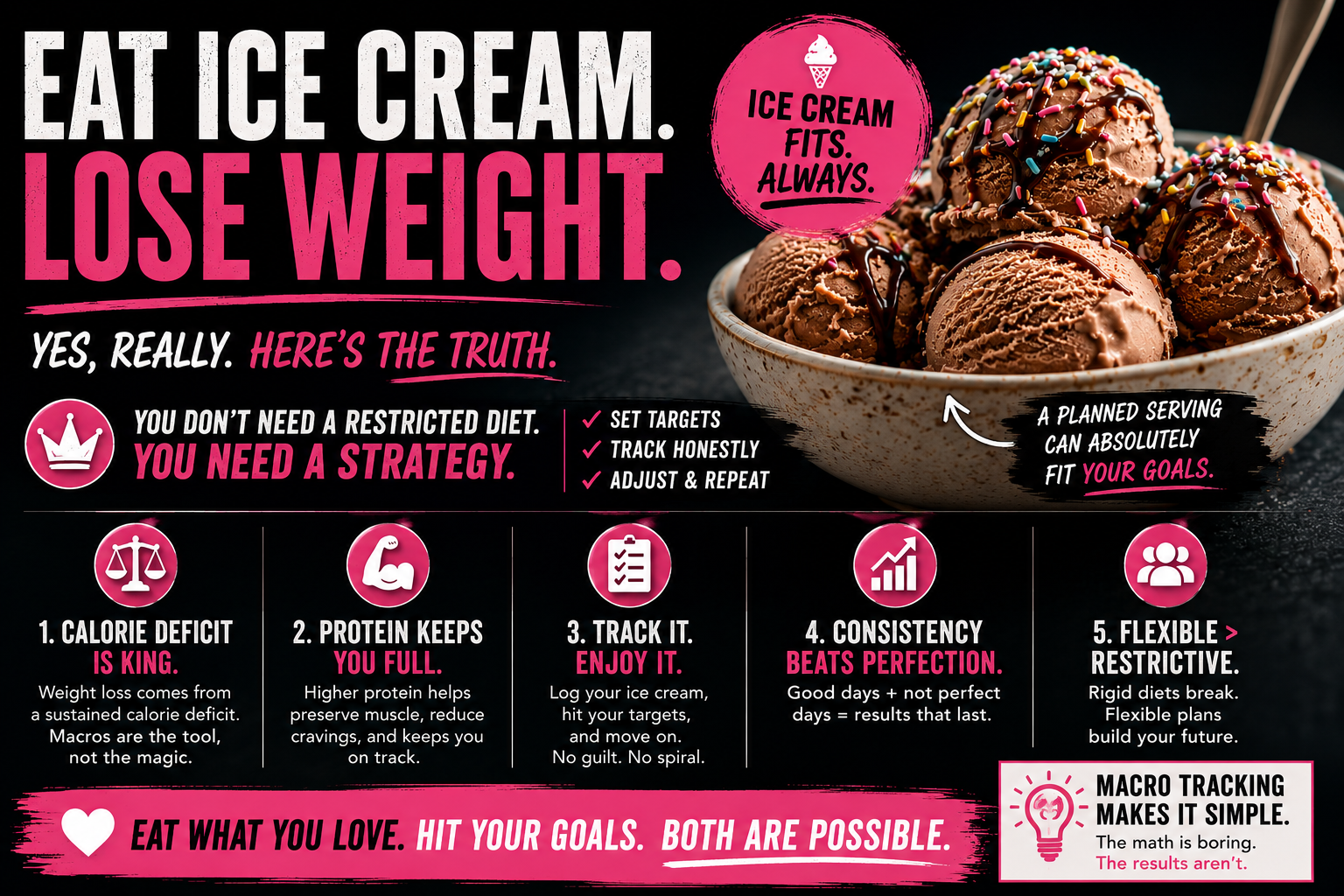
Those benefits start with a simple trade: structure without food fear. You are not proving morality with meals; you are matching portions to an evidence-based budget.
For definitions and label math, start with What Are Macros?. For setup order (calories → protein → fats → carbs), read How to Calculate Macros.
What is macro tracking?
Macro tracking means setting daily targets for protein, carbohydrates, and fat, then logging intake against those targets.
- Protein supports muscle retention, recovery, and satiety for many active people.
- Carbohydrates support training quality and daily energy.
- Fat supports hormones, satisfaction, and practical food flexibility.
Those macros still live inside a calorie budget, because calorie balance drives weight trend over time. Macro tracking is not “eat anything with zero consequences.” It is: eat what you want, in portions that match your goal.
If you want the calories-versus-macros distinction in one place, see Macro Calculator vs Calorie Calculator.
The science behind macro tracking: why it works
Adherence beats perfection
Weight-management research repeatedly reinforces a boring truth: the “best diet” is often the one people can stick to (Hall & Kahan, 2018). Flexible dieting via macro targets can reduce the all-or-nothing cycle because preferred foods are not automatically “off-plan.”
Energy balance still rules fat loss
Across dietary patterns, fat loss still requires a sustained energy deficit (Heymsfield et al., 2014). Macros are a way to build and defend that deficit without random restriction rules that collapse on weekends.
Higher protein tends to improve outcomes
Higher-protein approaches often help preserve lean mass and improve fullness during fat loss (Leidy et al., 2015; Morton et al., 2018). Macro tracking makes protein harder to “forget” when calories get tighter.
Flexible restraint can be easier to sustain than rigid rules
Rigid food rules (“never eat X”) increase rebound risk for many people. Flexible control (“I can fit X within today’s targets”) is often more sustainable—especially when paired with honest logging and weekly averages.
Macro tracking benefits: what you can realistically expect
You can include favorite foods without spiraling. Ice cream, pizza, or dessert can fit if the day is planned—see Sugar, Desserts, and Macros. That lowers “I blew it, so I’ll restart Monday” behavior.
Better muscle retention while losing fat is more likely when protein is protected. In a deficit, protein and resistance training matter; macro tracking supports both more reliably than calorie-only guessing for many lifters—pair with Muscle Retention While Cutting if you train hard.
Progress becomes more predictable. You adjust one variable at a time—calories, carbs, fats, or activity—based on trend data instead of emotional guesswork. When trends stall, use Fat Loss Plateau: When and How to Adjust Your Macros.
Less decision fatigue. Once targets exist, choices become math plus preference—not moral drama.
Stronger long-term maintenance skills. You learn real-world portions and tradeoffs, which is what maintenance actually requires after a cut.
The risks of macro tracking: what you must not ignore
Obsessive logging behavior. Some people chase exact grams and lose flexibility. Mitigation: aim for a realistic range, not robotic perfection—if this is you, also read Macro Tracker Burnout.
“If it fits your macros” junk-food misuse. Hitting numbers with low-satiety, low-micronutrient choices can backfire. Mitigation: keep an 80–90% whole-food base and 10–20% flexible foods.
Inaccurate tracking. Untracked oils, sauces, bites, and alcohol erase deficits quietly. Mitigation: tighten the basics in Macro Tracking Accuracy, and log weekends honestly.
Ignoring biofeedback. Sleep, energy, training output, and digestion still matter. Mitigation: pair metrics with reality—activity estimates belong in context too (Activity Level, NEAT, and TDEE).
Social friction without a plan. “Impulsive flexibility” is where calories slip. Mitigation: pre-log one enjoyable item and use Restaurant & Takeout Macros when you eat out.
How to do macro tracking correctly: precision over guesswork
Step 1: set starting targets with the calculator
Use the Macro Calculator to turn your stats and goal into a daily calorie budget and macro gram targets—about two minutes, no signup.
In the calculator (follow the form)
- Body stats: Enter weight, height, and age. Body fat % is optional—if you know it, the calculator can use it for more accurate macros (the form says: “If you know your body fat %, we can calculate more accurate macros.”).
- Sex: Choose Male or Female.
- Goal: Select Cut Fat, Build Muscle, Maintain, or Body Recomposition—for fat loss, choose Cut Fat.
- Activity level: Pick the option that matches your honest average week, not an aspirational one.
- Eating style: Choose how you eat (for example Standard, Keto, Carnivore, or PSMF). Keto, carnivore, and PSMF change how carbs and fats are set; PSMF also adds a large deficit versus TDEE—use the PSMF info icon on that card if you select it.
- Dietary restrictions & preferences: Toggle what applies and add other dietary notes if needed.
- Click Calculate Macros—you’ll get calorie and macro gram targets.
After you calculate
- Hit protein first—most people anchor the day around protein sources they can repeat.
- Keep calories in range—this is what keeps macro tracking for fat loss honest; a calorie deficit with macros is still a deficit.
- Allocate carbs and fats around training, appetite, and adherence—not Instagram ratios.
- Track daily, review weekly averages, then adjust slowly (often after 2–3 weeks of trend data).
- Re-run the calculator when weight, job activity, or training volume changes materially.
Sanity-check shape (not copy-paste) against Cutting macros and the Cutting macro calculator hub pages.
A sample fat-loss day with ice cream (logged)
This is a template, not a prescription—grams depend on your targets.
- Breakfast: Greek yogurt, berries, whey protein (protein anchor)
- Lunch: Chicken bowl with rice and vegetables (protein + carbs + fiber)
- Snack: Apple and light string cheese (volume + protein)
- Dinner: Lean beef tacos with measured toppings (protein + controlled fats)
- Dessert: one serving of ice cream, pre-logged (planned flexibility)
Why this works: dessert is planned, not impulsive. Protein stays high, calories stay controlled, and nothing has to be “off-limits” to still pursue lose weight without food restrictions in the practical sense—portion discipline, not food bans.
Who macro tracking is for (and not for)
Best for:
- People who want fat loss without rigid food bans
- Lifters who want to keep muscle while cutting
- Busy adults who need structure + flexibility
- Anyone tired of “good food vs bad food” dieting
Not ideal for:
- People with active eating-disorder patterns (without professional support)
- Anyone unwilling to track consistently for at least 2–4 weeks to get useful data
- People seeking instant results without behavior change
Macro tracking vs other diet approaches
| Protocol | Calorie level | Key macro focus | Best for | Difficulty |
|---|---|---|---|---|
| Macro tracking | Deficit, maintenance, or surplus | Protein + full macro targets | Flexible, sustainable body-composition goals | Moderate |
| Calorie counting only | Any | Calories only | Simplicity and scale-weight focus | Easy |
| Rigid meal plan | Often fixed | Preset meals, little flexibility | Short-term compliance with fewer decisions | Moderate–high |
| Food-group elimination (e.g., no carbs) | Often lower by default | Restriction-based rules | People who prefer hard boundaries | High (social/lifestyle friction) |
Common macro tracking myths (vs truth)
Myth #1: “If it fits your macros, food quality does not matter.”
Truth: Quality still matters for health, satiety, training, and recovery. Macros are the framework, not the entire nutrition story—see Macro Mistakes Stalling Fat Loss.
Myth #2: “Macro tracking means unlimited junk food.”
Truth: You can include fun foods, but portions still count. Calorie-dense extras break a deficit fast.
Myth #3: “You must track forever.”
Truth: Many people track tightly for a phase, then shift toward maintenance habits with better portion awareness.
Myth #4: “Alcohol is ‘free’ if it fits carbs.”
Truth: Alcohol adds calories and disrupts logging—budget it like food (Alcohol and Macros).
Practical tips for macro tracking success
Pre-log one enjoyable food daily so flexibility is planned, not reactive.
Anchor each meal with protein before spending remaining carbs and fats.
Use repeat meals on busy days to cut logging error—Macro Meal Planning helps.
Track weekends honestly; this is where many deficits disappear.
Adjust only after 2–3 weeks of trend data, not one random weigh-in—Fat Loss Plateau.
Revisit activity assumptions when your real week changes (Activity Level, NEAT, and TDEE).
Keep one “B+ logging” rule: perfect databases do not exist; consistent beats imaginary precision—Macro Tracking Accuracy.
Final take
Macro tracking is not about eating “clean” 24/7. It is about eating intentionally: a calorie deficit with macros when you want fat loss, protein protected for lean mass, and carbs and fats allocated for training and real life.
So yes—you can lose fat with ice cream on the menu most days when it is portion-budgeted, pre-logged, and your weekly averages still show a real deficit. Not because macros are magic—because precision beats restriction.
If you want targets that match your body, goal, and activity, run your numbers in the Macro Calculator and build the plan from there.
Scientific references
- Hall KD, Kahan S. Maintenance of Lost Weight and Long-Term Management of Obesity. Med Clin North Am. 2018.
- Heymsfield SB, et al. Energy Balance and Weight Loss. Int J Obes. 2014.
- Leidy HJ, et al. The Role of Protein in Weight Loss and Maintenance. Am J Clin Nutr. 2015.
- Morton RW, et al. Protein Intake to Maximize Resistance-Training–Induced Gains. Br J Sports Med. 2018.
Medical disclaimer: This content is educational and not medical advice. Consult a qualified healthcare professional before changing your nutrition, especially if you have a medical condition, are pregnant, breastfeeding, or have a history of disordered eating.
Try the free macro calculator
Set calories and macros for your goal in seconds—no signup required.
Open calculatorPhysiq App
Turn these targets into daily results.
The calculator gives you the plan. Physiq helps you execute it — fast meal logging, consistent tracking.
Free download · No subscription required
Related guides
- What Are Macros? Protein, Carbs, and Fat in Plain English
- How to Calculate Macros (Calories First—Then Grams That Stick)
- Macro Calculator vs Calorie Calculator
- Macro Tracking Accuracy: Scales, Oils & Honest Logs
- Fat Loss Plateau: When to Tweak Macros (Not Panic)
- 7 Macro Mistakes That Stall Fat Loss (And What to Do Instead)
Related macro pages
PHYSIQ MACRO TRACKER APP
Consistency wins. Track it with the Physiq Macro Tracker.
Calculate your macros here, then track them daily in the Physiq app.
- Fast food logging
- Macro target tracking
- Meal Planning
- Stay consistent